
“Renew supplier contract”
No company, accountable owner, approval path, evidence requirement or due date is explicit. A shared team has to reconstruct the context from messages.
SOVHELM / Operating guide
Published
When one team serves several companies, the danger is not simply too many tasks. It is a supplier request, approval, file or deadline losing the company, owner and evidence that make it meaningful.
This guide sets out a practical separation method for founder-led groups, family businesses, holding-company operators and shared finance or operations teams. It is operating guidance, not legal, tax or accounting advice.
Start with the boundary
Separate books, bank accounts, statutory registers and professional advice remain separate matters. The operating layer needs the same discipline: the team must be able to tell which company owns a request, who may decide it and where the proof belongs.
Illustrative comparison
No company, accountable owner, approval path, evidence requirement or due date is explicit. A shared team has to reconstruct the context from messages.
The company or legal entity, owner, assignee, approver, deadline, status and source document travel with the work.
Minimum operating record
Name the operating company and, where relevant, the legal entity affected. A venture label alone may not answer the ownership question.
Keep accountable ownership, the next person doing the work and protected sign-off as distinct responsibilities.
Record the next action, internal target and any final date. Mark whether work is open, blocked, waiting or ready for review.
Attach the relevant file, comment, decision and reference ID to the work rather than relying on a separate inbox thread.
Group view
A group-wide view is useful for finding exceptions: overdue approvals, blocked work, deadlines or workload that needs attention. It should route the viewer to the underlying company record, not flatten every company into one undifferentiated list.
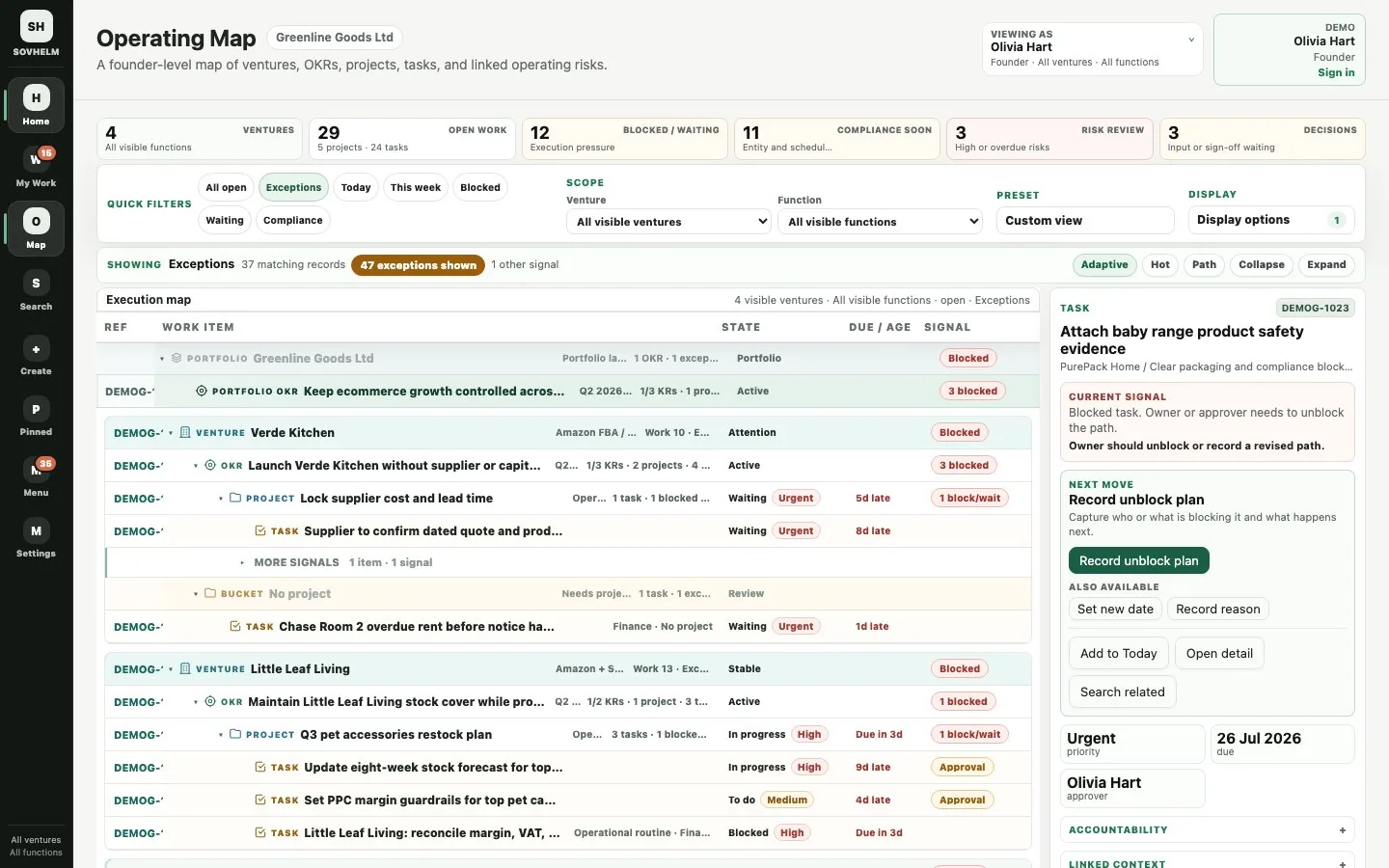
The Operating Map keeps portfolio, venture, project and task context visible together in the sample workspace.
Open full-size screenshotFor the team workflow, read shared finance across companies. For the product model, see multi-business management, holding company software and shared services operations.
Least-privilege access
Give a shared function access to the companies and records needed for its work. Keep restricted supplier discussion, decision material and files out of the view of people who do not need them. Test both a permitted and a restricted record with the intended roles before relying on the configuration.
SOVHELM supports role-scoped operating records. It does not replace legal entity administration, statutory registers or external systems of record. Review the Trust Center and validate the access model against the actual team before importing sensitive material.
Practical checklist
Illustrative example: a UK operating company, a US service company and a small holding company can share a finance team. A supplier-renewal request still needs the correct company, accountable owner, contract evidence and approval route before it is acted on.
Next step
The public demo uses sample records. Request a private walkthrough to map a real operating structure without sending sensitive records by email, or review the current pricing.
Further reading
For actual recordkeeping obligations, consult the relevant authority and your adviser. The IRS recordkeeping guidance and GOV.UK company and accounting records guidance are useful starting points for their respective contexts.